Thiên Long’s Open-Source Approach
Fourteen years ago, when Investor Relations (IR) was still a relatively new concept in Vietnam, Thien Long Group laid the foundations for its IR activities with the ambition to differentiate itself—first and foremost, in the way a listed company understood and fulfilled its responsibilities to shareholders.

Ms. Tran Phuong Nga, CEO of TLG
From a company with limited stock liquidity and initially little incentive to invest in Investor Relations (IR), Thien Long gradually transformed its approach to engaging with the financial markets.
Notably, the person who laid the foundation for IR at Thien Long, Ms. Tran Phuong Nga, has since risen to become the company’s Chief Executive Officer (CEO). Coming from the investment fund industry, Ms. Phuong Nga joined the stationery manufacturer as Chief Financial Officer (CFO) and gradually assumed the company’s highest executive role. Despite her increasingly demanding schedule, she has remained closely involved in IR.
“I am still on the email distribution list for shareholder-related information,” Ms. Phuong Nga shared in an interview with us. For the executive, IR at Thien Long has never been confined to the function of information disclosure. Rather, it serves as a broader channel for fostering alignment in corporate governance and generating intangible value for all stakeholders.
A Statement of Transparency
Thien Long has historically maintained a highly concentrated shareholder structure. As a result, major corporate decisions are, to some extent, less dependent on the votes of external shareholders. In other words, the Company may not necessarily need to “cater to” the market. Why, then, did Thien Long decide to develop its Investor Relations (IR) function in a systematic and professional manner?
Ms. Tran Phuong Nga, CEO of Thien Long: It was not because of voting considerations or a need to raise capital that we decided to pursue IR. Rather, we wanted to be a company that is genuinely transparent. Although we have a controlling shareholder, we continue to place great importance on respecting minority shareholders.
Moreover, IR is not solely intended to meet the information needs of external shareholders. It is also an internal statement of our commitment to transparency and sound corporate governance. At Thien Long, we have always aspired to stay ahead of the curve, regardless of whether a particular practice is formally required or mandated.
How, then, has IR contributed to improving the quality of corporate governance at Thien Long?
We have never wanted simply to follow procedures and comply with legal requirements. Instead, we aim to foster an environment built on the right mindset. In such an environment, IR should not be viewed as a compliance obligation, a passive function, or merely the routine disclosure of standardized forms. Rather, IR should serve as a two-way dialogue that helps optimize the Company’s value in the capital markets.
Once we move beyond a compliance-driven mindset, as demonstrated by the direct involvement of senior management in IR activities, the information communicated to the market becomes more substantive. It goes beyond reporting financial figures to provide analysis of the broader business context. This helps prevent information gaps that might otherwise lead investors to draw their own assumptions.
Thien Long also does not shy away from discussing the Company’s limitations or the competitive pressures it faces. We do not seek to steer or influence investors’ perceptions, because we believe doing so would be unfair.
At this point, IR is helping us further build and reinforce our governance standards and core value of integrity, rather than merely serving as a means of providing information.
Furthermore, through regular and trustworthy dialogue, sophisticated investors increasingly feel encouraged to share their own market experience and insights with us. Some of this feedback has subsequently been communicated to the Board of Directors (BOD) and the executive management team, helping us further strengthen the “G” (Governance) pillar of ESG. This, in turn, creates constructive pressure for us to continuously improve ourselves.
Today, people still ask why Thien Long needs to pursue ESG when customers have not yet imposed stringent requirements, and investors do not necessarily require it as a condition for providing capital. In essence, this is something we want to demonstrate: we have listened, we have absorbed what we have learned, and these insights are being meaningfully integrated into the continuous improvement of Thien Long.
We have built a sufficiently deep level of trust across our relationships. From there, a positive multiplier effect emerges, encouraging all parties to voluntarily work together to achieve better and more responsible outcomes. That is what we mean by a two-way mindset—not simply the exchange of information.
More broadly, beyond the governance aspect, when implementing IR at Thien Long, have the actual outcomes been in line with your expectations, or has anything surprised you?
I would say that the benefits have exceeded our expectations.
In 2012, Thien Long’s market capitalization was surprisingly low, even falling below its book value. Its P/E ratio was also extremely low and did not reflect the scale of the business. At that time, Thien Long was like a diamond in the rough that simply needed to be polished.
The changes we made to our IR practices helped accelerate the Company’s valuation. As a result, we were able to carry out a foreign investor placement at a relatively favorable price. The capital raised through that transaction enabled Thien Long to sustain its operations during the pandemic and continue its growth thereafter.
However, this is not merely a story about capital. The momentum generated by IR also strengthened the trust of B2B customers as well as consumers. I believe customers feel a greater sense of trust and pride when using products from a listed company with a stronger market capitalization and effective IR and ESG practices.
The value of IR also lies in its ability to strengthen employee commitment to the Company. Management, too, recognizes that we have made the right choices. These are all highly intangible forms of value.
In reality, investing in IR does not require a significant amount of money. Thien Long’s IR function is essentially led by one dedicated person and remains highly effective. I do not consider it a major financial investment. What matters most is the level of commitment behind it.
So, with IR, is the key not the amount invested, but rather the commitment and mindset embedded within the organization?
Choosing the right people is also a very important factor.
They must be individuals who align with the Company’s core values. At Thien Long specifically, that means integrity and dedication. These qualities must come before technical capabilities, which can be developed gradually over time through collaboration with different departments.
Professional investors can immediately recognize when we are not being honest. If they have entrusted us with a substantial portion of their wealth—and, in many cases, their future—why would we mislead them through distorted information? I have always believed that trust is extremely difficult to build but very easy to lose.
I also do not agree with the idea of assigning marketing personnel to handle IR, as there can be a tendency to make everything look better than it actually is. An IR professional, by contrast, needs a strong financial foundation, an in-depth understanding of the industry, and knowledge of valuation models. They must also be able to put themselves in the position of the audience—the investors—in order to provide content that is substantive, well-structured, and properly standardized, without distorting the information.
At Thien Long, we value diversity, cultural integration, diplomacy, and adaptability, particularly in roles involving corporate representation and communication. IR professionals need to understand different cultures and perspectives in order to avoid imposing their own assumptions on others. At the same time, they must continuously challenge themselves to improve, participate in meetings with senior management to gain a deeper understanding of the business, and thereby avoid limiting themselves to the role of simply communicating information.
“Reaping the Harvest Is Less Important Than Sowing the Seeds”

At Thien Long, how does the IR team currently measure the effectiveness of its activities?
Unlike many companies that place IR under the finance function, Thien Long positions IR directly under the executive management team, allowing the function to participate in senior-level meetings. This enables IR to provide management with both an inside-out perspective and an outside-in perspective.
Performance measurement is also not based solely on quantitative KPIs. It incorporates qualitative indicators, such as the level of satisfaction and feedback from internal stakeholders.
In addition, in recent years, Thien Long’s Board of Directors (BOD) and executive management have decided to measure an inherently difficult-to-quantify dimension: ESG performance. IR is also part of the “G” (Governance) pillar, contributing both to the monitoring and assessment of governance quality and being evaluated through the maturity and development of the Company’s corporate governance system.
However, ultimately, I believe that KPI metrics are inherently short-term in nature, whereas IR is a function oriented toward long-term value creation. If we place too much weight on share price or valuation when evaluating IR performance, employees may be incentivized to embellish the Company’s story with information that is not necessarily accurate, thereby distorting the long-term narrative for temporary gains.
In my view, for strategic roles with a long-term orientation, reaping the harvest is less important than sowing the seeds and nurturing the trees.
Turning to the business perspective, do you think that greater transparency could allow competitors in the same industry to understand Thien Long better than Thien Long understands them, thereby creating a competitive disadvantage?
Most of our competitors in Vietnam are not publicly listed companies, so naturally, they know more about us than we know about them.
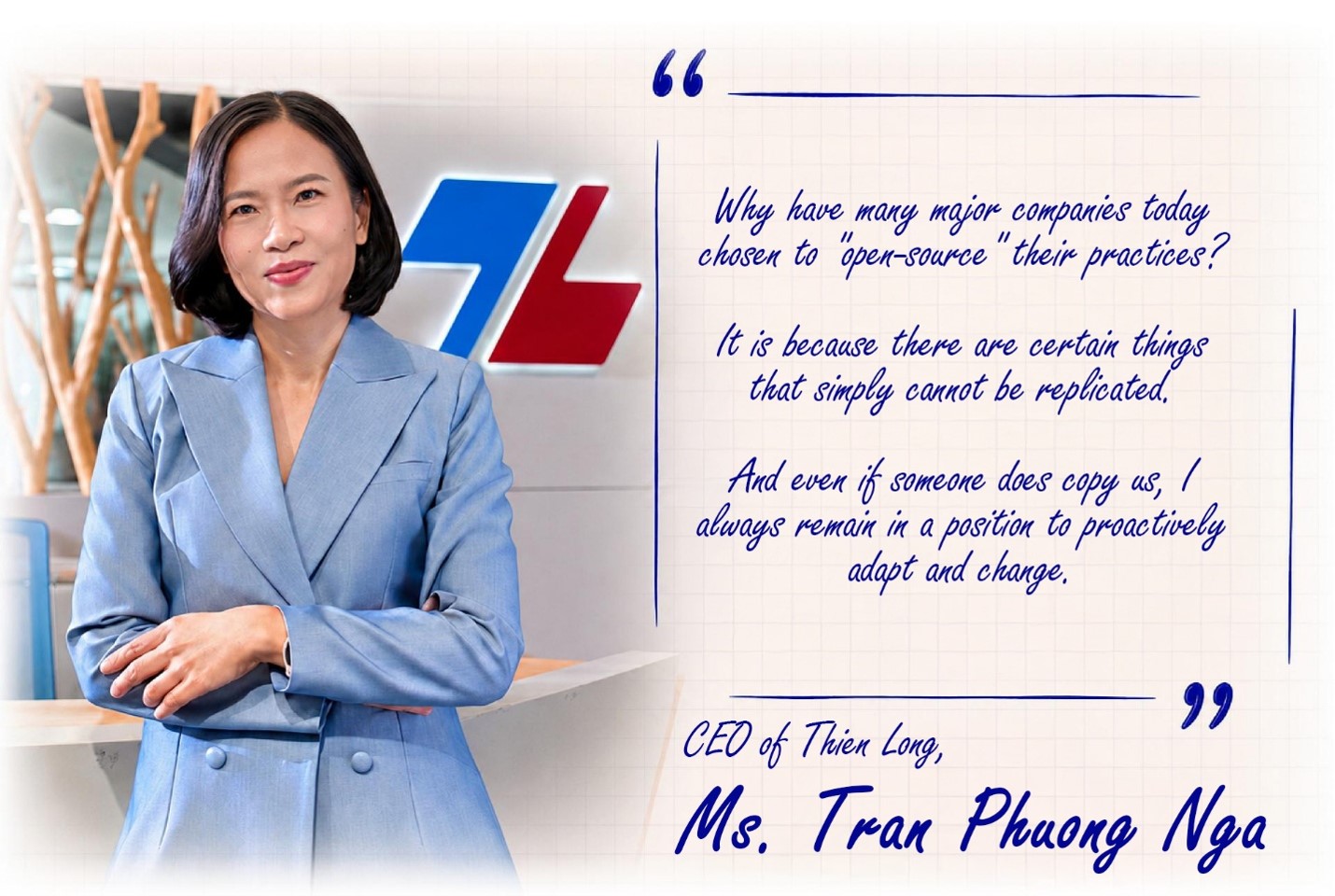
However, why have many major companies today chosen to “open-source” their practices?
It is because there are certain things that simply cannot be replicated. And even if someone does copy us, we remain in a position to proactively adapt and change.
At Thien Long, apart from information that is subject to confidentiality requirements—such as contracts with business partners and customers—we are confident enough and have no hesitation about sharing information. Once we have chosen the path of being a publicly listed company, we will not tell only half the story.
So how does Thien Long manage the level and scope of information disclosure in situations where transparency could potentially create a competitive disadvantage?
This requires a high level of expertise from the IR professional. This person needs to operate at both the strategic and IR levels. In the past, I personally took on this responsibility myself.
The Company’s spokesperson should be consistent and centralized to ensure message consistency and coherence. That individual must also be properly trained to understand what should and should not be disclosed. If certain information falls outside the scope of what can be disclosed, we will explain this clearly and are prepared to discuss the reasons immediately.
In reality, business dynamism cannot always be codified into rigid rules. Likewise, the appropriate level of information confidentiality is often context-dependent and time-sensitive. Therefore, an IR professional must possess broad and deep business knowledge and have appropriate access to information across the organization.
At Thien Long, a process of succession and restructuring is also underway. In the context of Vietnam’s market, where retail investors account for a significant proportion of market participation, it is common for major corporate changes to trigger unofficial speculation. How does the Thien Long team manage market expectations appropriately during such periods?
From the outset, we agreed—both within the Board of Directors and with external partners—on which information could be disclosed and which information could not. From there, we have remained disciplined in adhering to those principles and have made a conscious effort not to violate them.
In reality, whenever significant changes are taking place, there will inevitably be information that remains pending and cannot yet be disclosed.
As for external speculation, our message has always been clear: all official information is disclosed transparently and fairly through the Company’s website. I believe that is what professionalism means.
Vietnam is working toward an upgrade of its stock market, which will bring the market increasingly into contact with international investors with more sophisticated expectations. From the perspective of IR and corporate governance, what, in your view, will distinguish a company that performs “adequately” from one that truly impresses more sophisticated investors?
In my view, there are four factors that will guide everything else.
First, I would emphasize professionalism. And professionalism requires standards. The “G” in ESG is critically important, and IR itself must work in tandem with ESG. The key is to implement these practices in an integrated and measurable manner, supported by data.
Second, once a company aspires to align with international practices, its materials need to be provided comprehensively in both Vietnamese and English. As internationally aligned frameworks, such as integrated reporting, become increasingly adopted, foreign investors will gradually be able to access information directly, without having to rely on an additional layer of interpretation.
Third is the ability to engage in direct and regular dialogue with international institutional investors. Corporate responses need to be grounded in data and logic rather than formulaic diplomatic language. This is why Thien Long has proactively participated in domestic and international investment forums—not simply to promote the Company, but to strengthen our ability to engage directly with high-quality questions from professional investors.
Finally, the corporate governance framework must meet appropriate standards, from both the Board and executive management perspectives. The Board must demonstrate substantive independence, supported by effective Audit and Risk Management Committees. We need to act voluntarily and proactively, holding ourselves accountable before others are required to hold us accountable.
-Given the rapidly changing environment today, based on Thien Long’s experience with IR, if a company were to build its IR function from scratch today, what would be the biggest mistake it should avoid?
Every company has its own strategic direction and its own potential pitfalls. I will therefore frame my answer around what we have learned at Thien Long.
In reality, if we were to build our IR function from scratch again, I would still follow the same path. Leadership must take the lead. The head of the organization needs to understand the Company’s strategy and long-term ambitions. If the company simply establishes a department and delegates IR responsibilities to someone, the function is unlikely to develop sufficient depth. Only leadership can truly understand the pulse and culture of its own organization.
At Thien Long, we also would not want the finance, legal, or marketing departments to take on IR as an additional responsibility. Such an approach can easily result in the function being dominated by a particular professional perspective—for example, becoming overly focused on branding, excessively detailed in financial figures, or too heavily driven by legal considerations.
At the same time, the scale of the business is another factor that shapes IR and inevitably creates certain limitations. If Thien Long had a larger investor base and higher stock liquidity, I believe our IR platform could evolve beyond its current scope and become even more diverse and sophisticated.
I believe all companies that succeed in IR share one common principle: they put themselves in the position of the people they are communicating with. If management focuses solely on superficial metrics without considering the perspective of the stakeholders who ultimately benefit from the information, meaningful effectiveness will be difficult to achieve. If leaders do not reflect deeply, remain passionate, and understand both the pulse of the business and the expectations of investors, they cannot properly identify the problems that need to be solved.
Ultimately, I believe it comes down to responsibility, dedication, and connection. Without these three qualities, no problem can truly be solved. With all three in place, any challenge can eventually be overcome.
There may be times when progress is slow, and there may be mistakes along the way, but ultimately, we will reach the destination.
Thank you very much for your time.
(Vietstock, 2026, "Mã nguồn mở của Thiên Long', https://vietstock.vn/2026/08/ma-nguon-mo-cua-thien-long-737-1481471.htm?fbclid=IwY2xjawTyQaFwZG9mBWV4dG4DYWVtAzEwMABzcnRjBmFwcF9pZBAyMjIwMzkxNzg4MjAwODkyAAEe9yLpb8DvTslsVIf4XN1lx8cqGvTTnyw78jPcFNmIF_gvVd71MxrIkeEYi04_aem_InEq4OPmcrZziwepNyJrAw)